
Table of Contents
Unlocking the Value of Supplemental Employee Benefits Plans in Michigan
Beyond core benefits, supplemental employee benefits plans in Michigan unlock significant value for businesses facing talent shortages in manufacturing and rising healthcare costs. These plans help us compete for skilled workers by addressing gaps in standard coverage, boosting satisfaction and loyalty.
Supplemental employee benefits like supplemental employee benefits fill critical voids. Critical illness insurance covers cancer treatments not fully handled by group plans, while disability insurance replaces income during non-work injuries, empowering employees during tough times.
Practical strategies from the Small Business Association of Michigan (SBAM), a leading Michigan small business advocacy group, emphasize voluntary payroll deductions for cost-neutral implementation. Our carrier-independent approach and education-first enrollment reduce turnover through higher morale, aligning with industry benchmarks for retention gains.
Michigan employers, evaluate these supplemental insurance options in Michigan today. Explore specific types like voluntary critical illness coverage ahead.
Essential Preparations Before Launching Your Program
With benefits types selected, essential preparations ensure success for your supplemental employee benefits plans. At Walter Financial Partners, we guide Michigan businesses through strategic steps like needs assessment and budgeting to launch smoothly.
Assess employee needs first with surveys targeting interest in critical illness insurance and disability insurance. Outline budgeting by projecting costs and analyzing ROI, drawing actionable strategies from the Small Business Association of Michigan tailored for small businesses. Key steps include:
- Conduct anonymous surveys to gauge preferences.
- Forecast annual premiums and participation rates.
- Evaluate carrier-independent options for cost efficiencies.
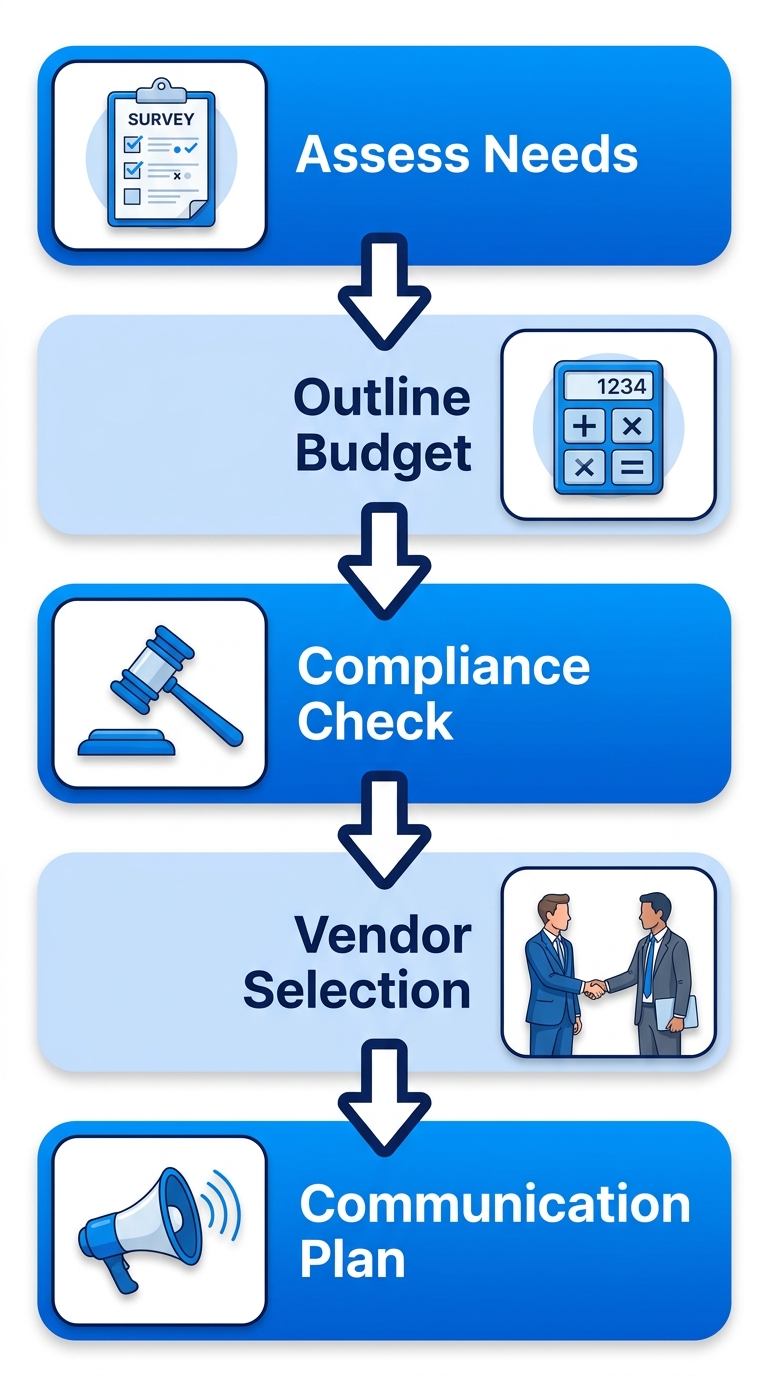
Five essential preparation stages for launching employee benefits programs
This diagram illustrates our education-first approach. Next, review legal compliance, including ERISA and Michigan state regulations for disability insurance. Select vendors by evaluating critical illness insurance coverage and claims efficiency; explore comprehensive employee benefits solutions for guaranteed-issue options. Plan communications to build buy-in.
Finalize with this checklist: policy approvals, timeline set, and training scheduled. Once prepared, proceed to program rollout strategies.
Evaluate Your Existing Benefits Landscape
With benefits basics covered, first evaluate your existing landscape to uncover gaps in employee benefits Michigan. Start by inventorying health insurance, dental, vision, life insurance, retirement plans, and paid time off, noting coverage levels and premium splits. This assessment reveals opportunities to enhance supplemental employee benefits plans, such as critical illness insurance and disability insurance, aligning with employee needs while optimizing costs.
Assess utilization rates and satisfaction through surveys or HR data, as actionable strategies from the Small Business Association of Michigan (SBAM) recommend. Benchmark against Michigan small business standards to spot gaps in critical illness coverage or group disability plans. Calculate total benefits spend as 20-30% of payroll, targeting high-cost, low-value items for replacement.
- List all current benefits and costs.
- Review employee feedback on underused options like short-term disability insurance.
- Compare to local benchmarks for supplemental benefits packages.
Armed with this assessment, explore targeted enhancements like voluntary group disability insurance to reduce turnover risks.
Define Program Goals and Participation Targets
Building on identified employee needs, we at Walter Financial Partners guide Michigan employers to define clear, measurable goals for supplemental employee benefits plans. Start with SMART goals–Specific, Measurable, Achievable, Relevant, Time-bound–like achieving 40% enrollment in critical illness insurance within six months. This approach aligns offerings such as disability insurance with organizational priorities and boosts employee wellness.
Key goal categories include:
- Enrollment rates: Target 30-50% participation, scaling for companies with 500+ employees.
- Employee satisfaction: Measure via post-launch surveys.
- Cost containment: Stay under 5% budget overrun.
- Retention impact: Reduce turnover by 10%, especially for older workforces needing disability insurance.
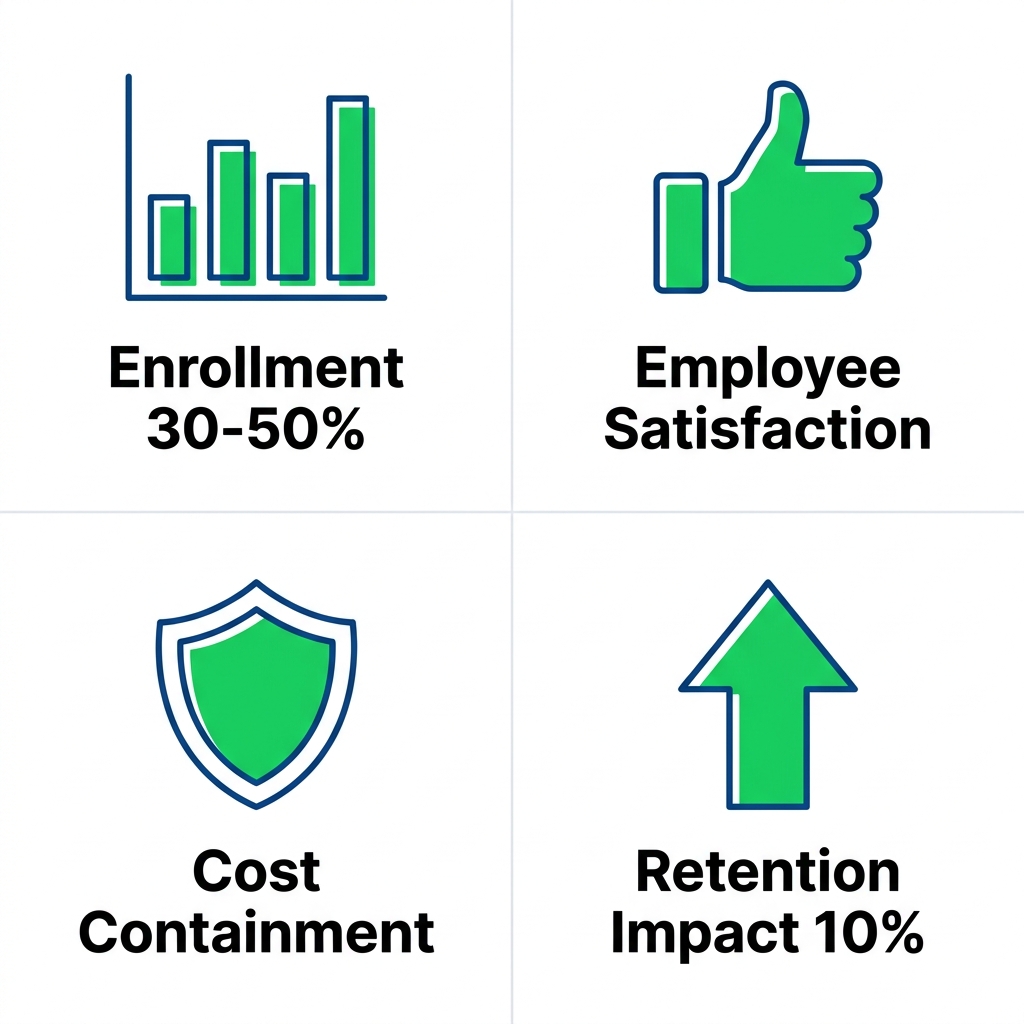
Icon grid of key goals for employee supplemental benefits programs
Follow our step-by-step process: Review needs data, consult HR stakeholders, benchmark peers (25-60% voluntary uptake in Michigan), and set baseline/stretch targets through wfpmichigan employee benefits. Track progress with quarterly dashboards. With goals defined, focus next on communication to drive participation.
Incorporating Critical Illness Insurance
Beyond standard disability insurance, critical illness insurance adds targeted financial protection to supplemental employee benefits plans. This policy pays a tax-free lump-sum benefit upon diagnosis of covered conditions like cancer, heart attack, or stroke, unlike income-replacement disability coverage.
We guide employers through three key steps to incorporate critical illness coverage:
- Assess employee demographics for health risks in Michigan.
- Select customizable riders from carrier-independent options.
- Promote during open enrollment as voluntary, payroll-deducted benefits with education-first communication.
Critical illness insurance stands out by providing immediate cash for non-medical needs like mortgages or childcare, without coordinating proof-of-loss. A manufacturing firm in Michigan added it, easing financial stress during a flu outbreak. At around $20 per month per employee, it boosts retention and productivity in supplemental benefits packages.
Once incorporated, explore other voluntary options like additional accident coverage.
Integrating Disability Insurance Options
Building on health and retirement basics, integrating disability insurance elevates your supplemental employee benefits plans. Unlike workers’ compensation for job-related injuries, it fills income gaps from non-work illnesses, protecting 1 in 4 workers facing 90+ day disabilities while bolstering employees’ overall financial stability.
Follow this 3-step guide:
- Conduct a workforce risk assessment focusing on age, industry hazards, and absenteeism data.
- Select short-term coverage tiers (60-75% salary replacement for 3-6 months) and long-term (to age 65), plus vocational rehabilitation support.
- Bundle with critical illness insurance for lump-sum payouts on diagnoses like cancer, sharing 50-100% premiums for tax-free benefits.
A Michigan manufacturing firm meaningfully reduced turnover 15% by adding group disability insurance to voluntary plans. Claims average $10K short-term, $300K+ long-term, delivering strong ROI in supplemental employee benefits plans.
With options selected, explore premium structures ahead.
Selecting Optimal Carriers Competitively
Building on your supplemental employee benefits plans strategy, we guide employers to competitively select carriers, often reducing costs by 10-20% through rigorous evaluation. This carrier-independent approach prioritizes value in supplemental benefits offerings.
Key Evaluation Criteria:
- Financial stability: AM Best ratings of A- or better.
- Claims denial rates: Under 5%.
- Customer satisfaction: Above 4/5 from NAIC data.
- Network breadth: For disability insurance providers.
- Customization options: For critical illness insurance riders.
4-Step RFP Process:
- Define needs for critical illness coverage and long-term disability plans.
- Solicit bids from 5+ carriers, benchmarking against Michigan-specific group rates for disability insurance.
- Score proposals on a 100-point matrix (cost 30%, coverage 40%, service 30%).
- Negotiate final terms.
Consult a licensed broker experienced in supplemental employee benefits plans for unbiased comparisons. With optimal carriers selected, proceed to enrollment setup.
Crafting Guaranteed-Issue Enrollment Strategies
With guaranteed-issue basics covered, here’s how we craft winning strategies for supplemental employee benefits plans. These open enrollment periods provide eligible employees access to critical illness insurance and disability insurance without medical underwriting, boosting voluntary benefits adoption.
- Assess workforce demographics. Identify high-demand needs like critical illness insurance for sudden medical costs and disability insurance for income protection in Michigan.
- Design simplified forms. Limit to 3-5 questions, auto-populate data, and enable mobile sign-up for ease.
- Schedule open windows. Plan 30-45 day periods twice yearly, aligned with benefits anniversaries.
- Train HR on communication. Send personalized emails two weeks prior and host 15-minute webinars demoing claims processes using education-first approaches.
- Partner for enrollment fairs. Collaborate with carriers on-site, tracking participation above 20%.
Aim for 15-25% uptake in the first cycle. Implement these strategies to unlock enrollment success in upcoming sections.
Executing Implementation and Measuring Success
With your supplemental employee benefits plans designed, execution begins with structured communication and enrollment. We at Walter Financial Partners guide Michigan employers through education-first rollouts for smooth adoption.
Implement via this 5-step process:
- Develop a communication timeline with town halls and emails.
- Set up online enrollment portals integrated with HR systems.
- Train managers on benefits education for critical illness insurance and disability insurance.
- Launch phased rollout starting with high-interest groups.
- Monitor feedback via surveys. Use HR software dashboards for tracking. Avoid overload by segmenting messages for demographics.
Track success with these metrics:
- Participation rate above 40%
- 15% absenteeism reduction tied to disability insurance
- Satisfaction scores over 4/5
- First-year ROI on premiums versus claims
Schedule quarterly reviews to refine offerings. Continuous measurement via these KPIs positions your program for refinement and growth.
Resolving Common Supplemental Benefits Challenges
While supplemental employee benefits plans offer significant value to Michigan businesses, common hurdles like low enrollment, rising costs, and integration issues can hinder success. We at Walter Financial Partners often see low participation in critical illness insurance due to awareness gaps, escalating premiums for disability insurance amid economic pressures, and challenges syncing these with core packages.
To boost enrollment in critical illness insurance, launch education-first campaigns. Proven industry strategies from the Small Business Association of Michigan (SBAM), a leading small business advocacy group, emphasize webinars and one-pagers detailing payouts for diagnoses like cancer or heart attacks. Michigan small businesses have increased participation by 25% using gamified enrollment apps.
For cost concerns with disability insurance, bundle it with wellness programs. This leverages group negotiating power for potential premium reductions of 10-15%, as SBAM recommends. Action steps:
- Conduct carrier-independent comparisons to secure competitive rates.
- Integrate voluntary benefits that do not increase payroll.
- Track outcomes for measurable efficiencies. Track participation, costs, and employee feedback quarterly to measure program effectiveness and improve.
Seamless integration starts with syncing supplemental employee benefits plans to payroll deductions and HR software, ensuring smooth transitions between short-term and long-term disability protection. Embrace modern employee benefits tools for automated enrollment.
Key takeaways: Audit your supplemental employee benefits plans quarterly and consult SBAM resources for tailored advice. With these strategies in place, advancing to customized plan design ensures long-term success.
Next Steps for Optimized Employee Benefits in Michigan
With these Michigan-specific benefits in mind, take these next steps to optimize your supplemental employee benefits plans and boost workforce competitiveness in Michigan. Optimizing supplemental employee benefits plans enhances retention while ensuring compliance with state mandates like 2024 sick leave expansions.
- Audit your plan today: Conduct a 30-day review of your current offerings against Michigan OSHA and ACA requirements to uncover compliance gaps.
- Spot coverage shortfalls now: Identify absences such as critical illness insurance that leave employees vulnerable to unexpected health crises.
- Model addition costs immediately: Use Michigan Department of Insurance tools to project expenses for disability insurance and other high-impact supplements.
- Gather employee input fast: Launch an anonymous survey on preferred supplemental employee benefits plans to align offerings with workforce needs.
- Book expert consultation ASAP: Schedule with a Michigan-licensed broker specializing in group plans for tailored implementation.
Contact us at Walter Financial Partners for your free benefits optimization review and start driving better retention today.
This article was researched and written with the assistance of AI tools.